Usage and Examples
Overview
Usage
Basically all you need to diff two json with JYCM is as follow
ycm = YouchamaJsonDiffer(left, right)
ycm.diff()
result = ycm.to_dict()
where
- ycm = YouchamaJsonDiffer(left, right) is used to setup the class;
you can specify other parameters to extend the ability of default ones.
usage parameters are shown in below
- ycm.diff is used to call the real diff
where the core diff functions are executed
- ycm.to_dict is used to get the result.
will return a dict
detail about the dict is explained right below
Return
What ycm.to_dict return is a dict whose keys are names of the diff-events, and values are list of dict which contains all relative info.
There’s six default diff-events:
- dict:add
keys being inserted comparing the old one
- dict:remove
keys being removed comparing the old one
- list:add
item being inserted comparing the old one
using LCS to match
- list:remove
item being removed comparing the old one
using LCS to match
- value_changes
values being changed
All the relative info at least contains these keys:
- left
the paired old value
- right
the paired new value
- left_path
the paired old json path
- right_path
the paired new json path
when it comes old/new value does not exist (for example dict:add indicting old value on the json path does not exist) a str __NON_EXIST__ will be held.
Default behaviour
These examples below will show the default behaviours when it comes to comparing two json values. It will give you a sense what will be returned from the YouchamaJsonDiffer.to_dict after you call YouchamaJsonDiffer.diff.
left = {
    "a": 1,
    "b": 2,
    "d": "12345",
    "f": False,
    "e": [
        {"x": 1, "y": 1},
        {"x": 2, "y": 2},
        {"x": 3, "y": 3},
        {"x": 4, "y": 4},
    ]
}

right = {
    "a": 1,
    "b": 3,
    "c": 4,
    "f": True,
    "e": [
        {"x": 0, "y": 1},
        {"x": 2, "y": 2},
        {"x": 3, "y": 3},
        {"x": 5, "y": 5},
    ]
}

ycm = YouchamaJsonDiffer(left, right)
ycm.diff()

expected = {
    'dict:add': [
        {'left': '__NON_EXIST__',
         'left_path': '',
         'right': 4,
         'right_path': 'c'}
    ],
    'dict:remove': [
        {'left': '12345',
         'left_path': 'd',
         'right': '__NON_EXIST__',
         'right_path': ''}
    ],
    'list:add': [
        {'left': '__NON_EXIST__',
         'left_path': '',
         'right': {'x': 5, 'y': 5},
         'right_path': 'e->[3]'}
    ],
    'list:remove': [
        {'left': {'x': 4, 'y': 4},
         'left_path': 'e->[3]',
         'right': '__NON_EXIST__',
         'right_path': ''}
    ],
    'value_changes': [
        {'left': 2,
         'left_path': 'b',
         'new': 3,
         'old': 2,
         'right': 3,
         'right_path': 'b'},
        {'left': 1,
         'left_path': 'e->[0]->x',
         'new': 0,
         'old': 1,
         'right': 0,
         'right_path': 'e->[0]->x'},
        {'left': False,
         'left_path': 'f',
         'new': True,
         'old': False,
         'right': True,
         'right_path': 'f'}
    ]
}
assert ycm.to_dict(no_pairs=True) == expected
Above is the example of default behaviours. All the default events are shown and you can check if the results are as you expected.
For better understanding here’s a graph of the diff result where the red stands for “remove” and the green stands for “insert” and blue stands for “change”. BTW I will release this rendering component soon
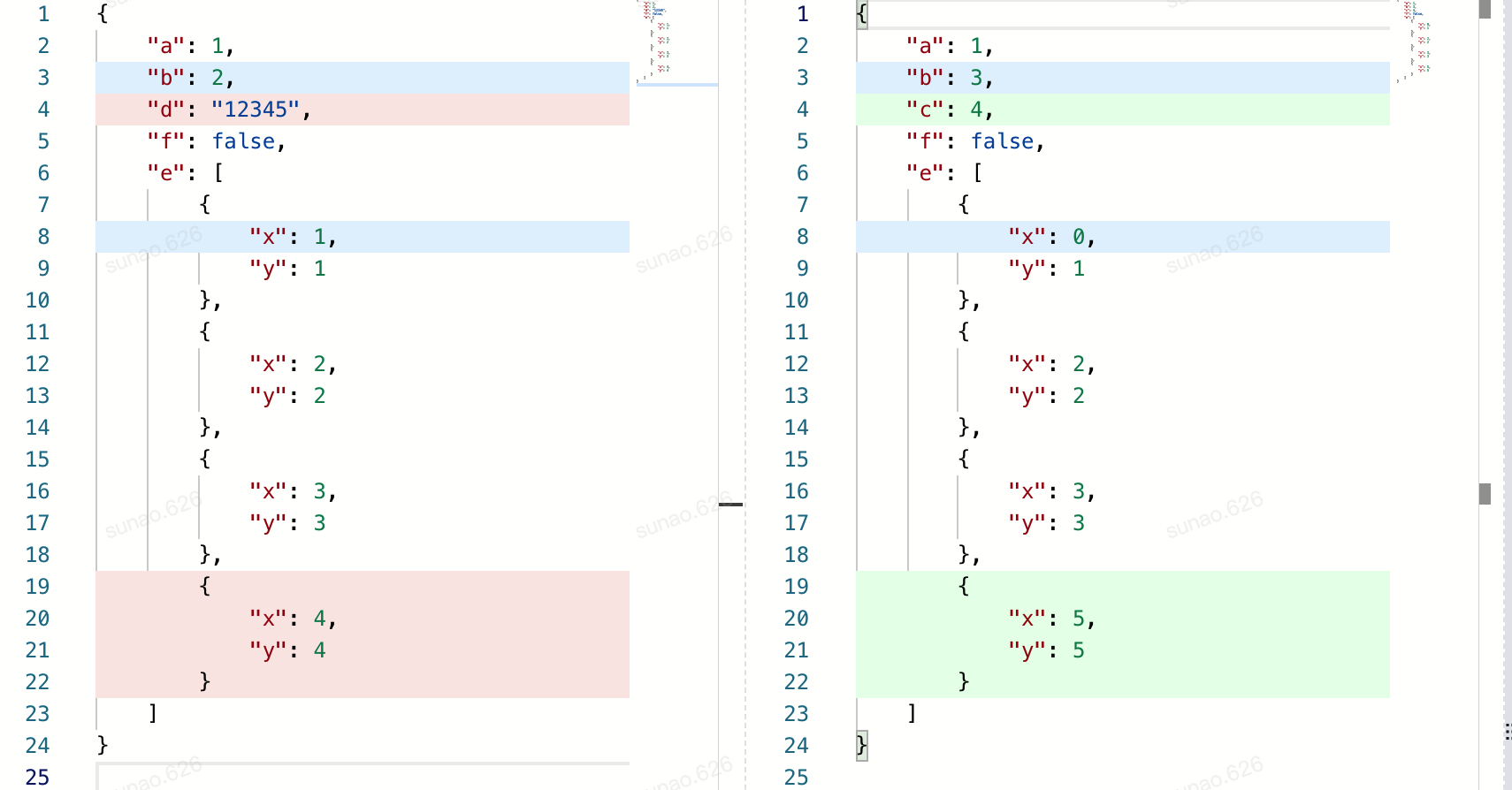
As you can see JYCM is smart: for example, it knows there’s a value_changes on e->[0]->[x] and a remove on e->[3] of left and an insertion on e->[3] of right.
For more information, you can check the Design.
Ignore Order
When it comes to set, things are getting interesting. YouchamaJsonDiffer provides a parameter ignore_order_func
to determine whether the values comparing should ignore order or not.
You can use the helper function make_ignore_order_func from ycm.helper to make this function which takes into a list of json path regax as parameters. Here’s the example:
left = {
    "ignore_order": [1, 2, 3],
    "not_ignore_order": [1, 2, 3]
}

right = {
    "ignore_order": [3, 2, 1],
    "not_ignore_order": [3, 2, 1]
}

ycm = YouchamaJsonDiffer(left, right, ignore_order_func=make_ignore_order_func([
    "^ignore_order$"
]))
ycm.diff()
expected = {
    'list:add': [
        {'left': '__NON_EXIST__',
         'left_path': '',
         'right': 2,
         'right_path': 'not_ignore_order->[1]'},
        {'left': '__NON_EXIST__',
         'left_path': '',
         'right': 1,
         'right_path': 'not_ignore_order->[2]'}
    ],
    'list:remove': [
        {'left': 1,
         'left_path': 'not_ignore_order->[0]',
         'right': '__NON_EXIST__',
         'right_path': ''},
        {'left': 2,
         'left_path': 'not_ignore_order->[1]',
         'right': '__NON_EXIST__',
         'right_path': ''}
    ]
}
assert ycm.to_dict(no_pairs=True) == expected
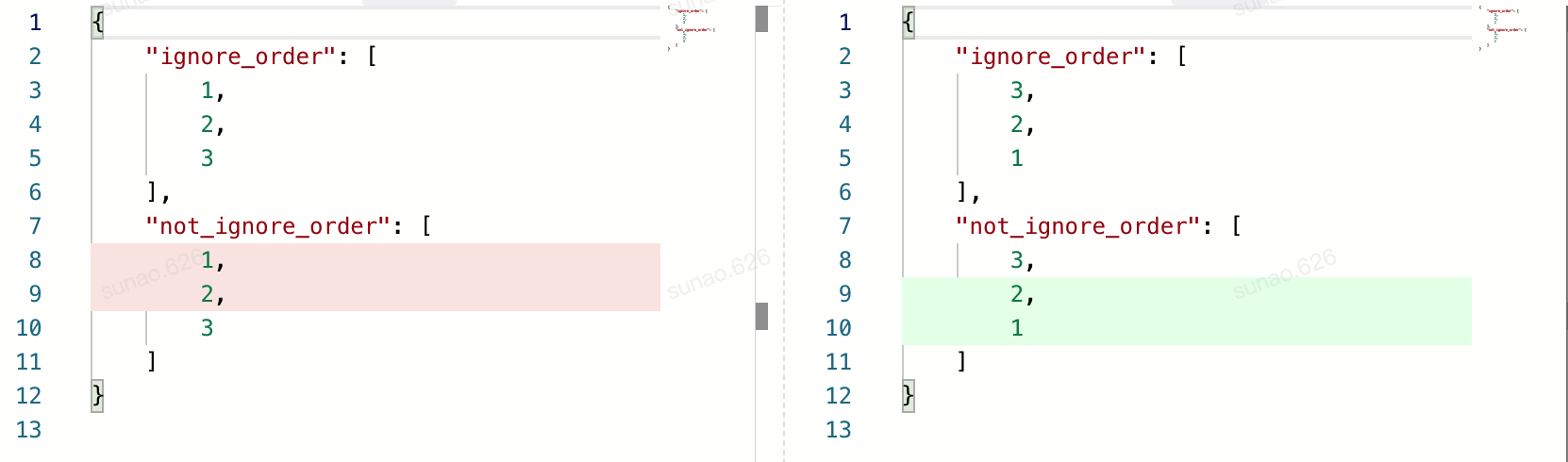
And here’s the graph:
Default Operators
There’s some operators implemented in JYCM out of the box.
IgnoreOperator
IgnoreOperator is for ignoring all the changes. Instead, a “ignore” event is reported.
left = {
    "ignore_me_remove": 1,
    "ignore_me_change": 1
}

right = {
    "ignore_me_add": 1,
    "ignore_me_change": 2
}

ycm = YouchamaJsonDiffer(left, right, custom_operators=[
    IgnoreOperator("ignore_me")
])
ycm.diff()
expected = {
    'ignore': [
        {'left': '__NON_EXIST__',
         'right': 1,
         'left_path': '',
         'right_path': 'ignore_me_add',
         'path_regex': 'ignore_me',
         'pass': True},
        {'left': 1,
         'right': 2,
         'left_path':
         'ignore_me_change',
         'right_path': 'ignore_me_change',
         'path_regex': 'ignore_me',
         'pass': True},
        {'left': 1,
         'right': '__NON_EXIST__',
         'left_path': 'ignore_me_remove',
         'right_path': '',
         'path_regex': 'ignore_me',
         'pass': True}
    ]
}
assert ycm.to_dict(no_pairs=True) == expected
And here’s the graph:

ExpectExistOperator
Custom Operators
Sometimes the distance function (or the function metering similarity) are more domain based.
For example, there’s a json representing two points (named distance_ok and distance_too_far) on 2D space:
left = {
    "distance_ok": {
        "x": 1,
        "y": 1
    },
    "distance_too_far": {
        "x": 5,
        "y": 5
    },
}

right = {
    "distance_ok": {
        "x": 2,
        "y": 2
    },
    "distance_too_far": {
        "x": 7,
        "y": 9
    },
}
How on earth a diff framework would know if they are the same or not ? It is where custom operator kicks in.
You can define an operator as following:
from jycm.operator import BaseOperator

class L2DistanceOperator(BaseOperator):
    __operator_name__ = "operator:l2distance"
    __event__ = "operator:l2distance"

    def __init__(self, path_regex, distance_threshold):
        super().__init__(path_regex=path_regex)
        self.distance_threshold = distance_threshold

    def diff(self, level: 'TreeLevel', instance, drill: bool) -> Tuple[bool, float]:
        distance = math.sqrt(
            (level.left["x"] - level.right["x"]) ** 2 + (level.left["y"] - level.right["y"]) ** 2
        )
        info = {
            "distance": distance,
            "distance_threshold": self.distance_threshold,
            "pass": distance < self.distance_threshold
        }

        if not drill:
            instance.report(self.__event__, level, info)
        return True, 1 if info["pass"] else 0
Here’s two things you should notice:
extends your class with BaseOperator which is imported from jycm.operator module
implement a diff function whose signature is as above.
Here’s more detail about the signature:
- Parameters
level is the instance of
TreeLevelwhich is the base element being compared in JYCMinstance is the instance of
YouchamaJsonDiffergiving you full control of the process
normally calling instance.report is enough
which is for reporting the diff event
drill is a bool function indicting whether this diff call is in reporting phase or not
drill is False when it is in the reporting phase
otherwise just a normal diff call (e.g. in the matching-items-in-array phase)
- Return
the first is a bool which indicting whether the diff space should be stopped from this operator
an example is ignore which returns True since whether the level or its children are different or not is irrelevant
the second is a float number in [0,1] mapping the similarity of the level.left and level.right. 1 is for they being are same while 0 is for they being not the same at all.
TIPS similarity maybe different in drill phase. (for example, in the matching phase, two items in array who have the same id field are the same even though they are different in other fields which should be reported in the reporting phase)
then you can simply init your class and pass it in to the custom_operators
ycm = YouchamaJsonDiffer(left, right, custom_operators=[
    L2DistanceOperator("distance.*", 3),
])

ycm.diff()

expected = {
    'operator:l2distance': [
        {
            'left': {'x': 1, 'y': 1},
            'right': {'x': 2, 'y': 2},
            'left_path': 'distance_ok',
            'right_path': 'distance_ok',
            'distance': 1.4142135623730951,
            'distance_threshold': 3,
            'pass': True
        },
        {
            'left': {'x': 5, 'y': 5},
            'right': {'x': 7, 'y': 9},
            'left_path': 'distance_too_far',
            'right_path': 'distance_too_far',
            'distance': 4.47213595499958,
            'distance_threshold': 3,
            'pass': False
        }
    ]
}
assert ycm.to_dict(no_pairs=True) == expected
Vola!